Ann Arbor Public Schools is maximizing taxpayer investment by accessing local, state, and federal incentives that effectively stretch funding further. This expands the use of bond and sinking fund dollars, allowing the District to complete more critical infrastructure projects and better serve the students.
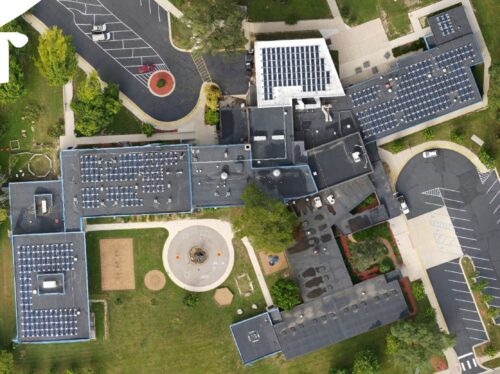
At the start of November, 2025, the Ann Arbor Public Schools received a check for $572,000 from tax credits for installing rooftop solar arrays on District buildings. This funding will come back to the Capital Programs to continue investing in critical repairs, updates, and new facilities. When voters approved bond funding for capital improvements across Ann Arbor Public Schools, they made a significant investment in student facilities and infrastructure. Now, the District is multiplying that investment by strategically accessing available tax credits, grants, and incentives that give every bond dollar even greater impact. By leveraging programs like solar tax credits, electric vehicle rebates, electric bus grants, geothermal incentives, and utility rebates, AAPS is extending the capacity of bond funding to complete additional projects that benefit students and the community. This strategic use of funds is one important step in creating a sustainable school system that maintains the highest level of fiscal responsibility.
Five Key Takeaways on Strategic Funding Through Incentives:
- Bond and Sinking Fund dollars remain the foundation of capital projects, but state and federal incentives multiply its impact by offsetting significant project costs.
- Incentives aren’t “extras”—they’re strategic financial tools specifically designed for public institutions like school districts to maximize infrastructure investments, such as the $572,000 in tax credits the District just received.
- When AAPS receives incentive funding for qualifying projects, those saved bond dollars become available to reinvest in additional critical improvements across the district.
- The District has accessed multiple incentive programs including state of Michigan programs, DTE Energy electrification grants, Trade Association grants (such as the Softwood Lumber Board’s Mass Timber Award) and other sources. Unfortunately, the Federal incentives for the district’s work have been eliminated by recent congressional action.
- This approach demonstrates fiscal stewardship by ensuring taxpayer-approved bond funding accomplishes more than it could through traditional spending alone.
Understanding How Incentives Extend Bond Capacity
If you were renovating your home and discovered you qualified for a tax credit that covered 30% of your solar panel installation, you’d suddenly have more money in your renovation budget for other improvements—maybe investing in higher quality shingles for your roof, or stepping up to a higher efficiency rating for the HVAC system you’d been considering. The same principle applies to how Ann Arbor Public Schools strategically uses available incentives to extend bond funding capacity.
When the District installs solar panels on school buildings, for example, federal solar tax credits can offset a significant portion of those costs. Similarly, when AAPS purchases electric buses, federal and state Clean School Bus grants and electric vehicle tax credit rebates reduce the net cost substantially. These savings don’t disappear—they remain within the Capital Projects program, available to fund additional improvements that voters approved through the bond measure. Unfortunately, due to recent policy changes, congress voted to eliminate solar tax credits, EPA funding for electric school busses and electric vehicle rebates. Going forward, the district will seek out State incentives, grants and other program sources to make the best investment of Bond funding.
This concept of “revolving funds” means bond dollars work harder. Instead of spending the full bond allocation on solar panels alone, the District can complete the solar installation using a combination of bond funding and tax credits, then reinvest the saved bond dollars into other critical projects. Jason Bing, Director of Capital Programs for AAPS shared that “… In the simplest math terms, in our first 10 new construction or major modernization projects, when factoring both solar and geothermal exchange credits, we could be looking at a $3 to $5 million return from those incentives for each one of those projects. So for all ten, that’s $30 to $50 million, and that can fund a whole other major project all by itself in just those incentive dollars. It’s a significant amount of money.” The initial taxpayer investment hasn’t increased, but its impact has multiplied.
A Portfolio of Strategic Incentive Programs
Ann Arbor Public Schools accesses multiple incentive programs that align with the District’s capital improvement priorities and environmental sustainability goals. Each program serves as a financial multiplier for specific project types:
Solar Energy Tax Credits: Until recently, federal investment tax credits for solar installations can cover up to 30% of project costs. For completed solar array installations on school buildings—a key component of the District’s renewable energy transition— the district will receive these substantial credits free up bond funding for other facility improvements while advancing sustainability goals simultaneously.
Electric Bus Grants and Vehicle Tax Credits: Although no longer available, the EPA’s Clean School Bus Program and federal electric vehicle tax credit rebates significantly reduced the cost of transitioning to zero-emission student transportation. “Our school district, board of education, and community understand the benefit of having no emission buses while our young ones are waiting in line, it’s a much quieter ride, it’s smoother, it’s lower cost to maintain. So Electric Buses have many, many other benefits.” Moe Nagpal, AAPS Capital Programs Manager, explained. “These incentives are intended to equalize a school district’s upfront payout between a new diesel bus and a new electric bus. Those incentives—a rebate, a grant or tax credit—essentially even out the cost.” This means that AAPS was able to replace 4 buses on the district’s schedule and expected cost, while still working toward the ultimate goal of creating a zero-emission bus fleet.
Geothermal Tax Credits: Federal tax credits for geothermal heating and cooling systems help offset the upfront costs of installing these highly efficient climate control solutions. Although not directly eliminated by recent congressional action, the restructuring of the prior administration’s Inflation Reduction Act will have long-term consequences for any Federal tax credits or rebates related to offsetting the higher up-front cost of low/no emission energy solutions. Currently, geothermal systems still qualify for incentives at the state and federal levels that continue to reinvest into the Capital Programs and protect bond funding to invest into more of the district’s buildings.
Green Infrastructure Incentives: Both tax credits and competitive grants support sustainable building improvements like efficient water systems, high-performance building envelopes, and improved air quality measures. These programs reward districts for choosing environmentally responsible infrastructure solutions that also generate long-term operational savings. The state of Michigan is still investing into environmentally conscious options for schools and other public entities to lower energy use, save money on operations long-term, and reduce emissions.
DTE Energy Electrification Grants: AAPS’s energy provider offers grants specifically for electrification projects that reduce natural gas dependency. These local utility incentives complement federal programs, providing additional financial support for projects like electric heating systems and kitchen equipment upgrades.
Additional Utility Credits and Rebates: Energy efficiency improvements often qualify for utility company rebates that reduce project costs. LED lighting upgrades, high-efficiency HVAC systems, and building automation improvements can all generate credits that stretch bond dollars further.
Real Impact: What This Means for Students and Facilities
The financial strategy of leveraging incentives translates directly into tangible improvements across the District. This multiplier effect means AAPS can:
- Complete more building envelope improvements. Better insulation, more efficient windows, and upgraded roofing—these create comfortable learning environments while reducing long-term energy costs. Energy cost savings mean more available funding in the general fund, without adding a millage or other cost increases for local taxpayers.
- Invest in both renewable energy generation and building mechanical system upgrades, rather than having to choose one over the other. Access to these tax credits free up bond funding to invest in both creating electricity and using it to power the more efficient systems within the building like geo-thermal HVAC systems and LED lighting.
- Modernize student transportation and upgrade facilities simultaneously. Electric bus grants allow the District to transition to cleaner, quieter buses without depleting the bond capacity needed for critical building improvements.
- Accelerate the timeline for critical improvements. Accessing grant funding and tax credits allows projects to move forward more quickly than if they relied solely on bond funding allocation schedules.
Fiscal Responsibility and Transparency
These incentive programs aren’t creative accounting or budgetary gimmicks—they’re legitimate, established government programs specifically designed to help public institutions like school districts invest in sustainable infrastructure. The federal Investment Tax Credit for solar energy, the EPA Clean School Bus Program, and similar initiatives exist precisely to support public infrastructure improvements that benefit communities while advancing environmental goals.
Ann Arbor Public Schools treats this taxpayer-approved bond funding with the responsibility it deserves. Every incentive dollar accessed means more completed projects, more improved facilities, and greater return on the community’s investment. The District’s Capital Projects team actively monitors available incentive programs, evaluates project eligibility, and strategically sequences improvements to maximize both bond funding and incentive opportunities.
This approach requires careful planning and coordination. Projects must meet specific criteria to qualify for various incentives, and applications often involve competitive processes. The District’s Capital Projects staff works closely with engineers, architects, and program administrators to ensure AAPS successfully accesses available funding while maintaining project timelines and quality standards.
Building Partnerships for Financial Success
Successfully leveraging incentives requires strong partnerships with federal agencies, state programs, and local utilities. AAPS works collaboratively with the U.S. Environmental Protection Agency, Department of Energy, Michigan Department of Environment, Great Lakes, and Energy, and DTE Energy to navigate application processes, ensure compliance with program requirements, and maximize available funding opportunities.
These partnerships extend beyond simply accessing dollars. Engaging with federal agencies on programs like Clean School Bus grants provides technical assistance that ensures projects meet stringent environmental and safety standards. Working with utility companies like DTE on electrification grants helps the District plan infrastructure improvements that align with grid capacity and energy efficiency goals. Collaborating with trade associations like the Softwood Lumber Board provides best-in-class research and material science into the development of 21st Century learning spaces.
Looking Ahead: Commitment to Strategic Stewardship
As Ann Arbor Public Schools continues implementing the Capital Projects program, the strategic use of incentives remains central to fiscal planning. The District will continue identifying and pursuing opportunities to apply for grants, tax credits, and rebates to extend bond funding capacity. The District and the Capital Programs team want to ensure that the community’s investment accomplishes maximum impact.
This commitment to strategic funding applications reflects AAPS’s broader dedication to fiscal responsibility. Taxpayers deserve to know their approved bond funding is being used strategically, that every available resource is being leveraged, and that the District actively seeks ways to accomplish more with the community’s investment.
Conclusion
The availability of specific incentive programs is constantly evolving with changes in federal and state priorities, but Ann Arbor Public Schools remains committed to accessing every appropriate funding mechanism that allows bond dollars to achieve greater impact. By combining voter-approved bond funding with strategic incentive programs, AAPS ensures that critical infrastructure improvements move forward efficiently, economically, and with the transparency the community expects.
When you see solar panels on school rooftops, electric buses transporting students, or upgraded mechanical systems creating comfortable learning environments, know that strategic incentive funding helped make those improvements possible. The District’s commitment to using incentives means your bond investment is working harder, going further, and creating better facilities for Ann Arbor Public School students.